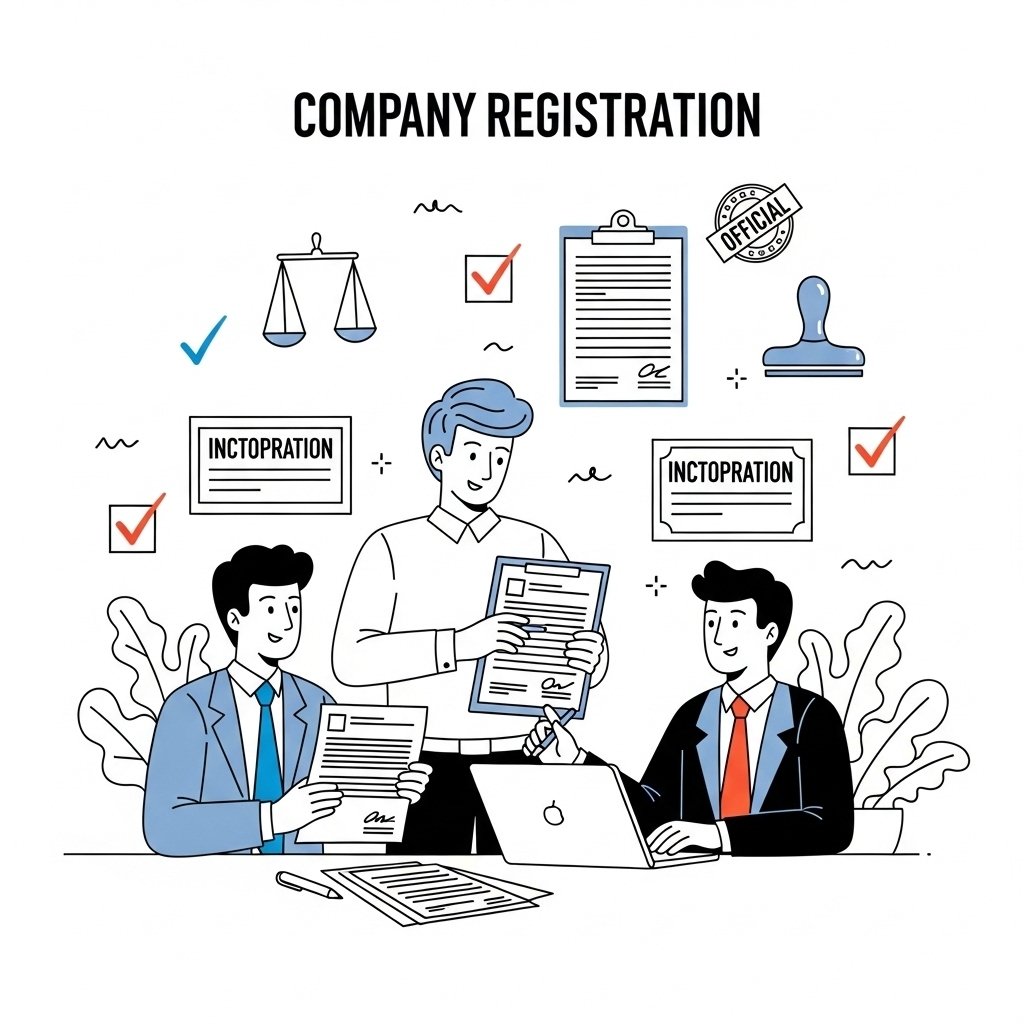


1 Ultimate Checklist for Successful Company Registration in India (2026)
Last Reviewed on: July 2026
Gathering the correct documents required for company registration in India is the difference between a smooth 7-day launch and a month of frustrating government rejections. Navigating the Ministry of Corporate Affairs (MCA) portal demands precision, and even minor discrepancies in your identity or address proofs will halt the entire process.

What are the exact documents required to register a business?
- Director Identity: PAN card (mandatory) plus Aadhaar, Voter ID, or Passport.
- Director Address: Bank statement or utility bill strictly less than two months old.
- Registered Office: Recent electricity bill, a No Objection Certificate (NOC) from the owner, and a rent agreement.
- Key Authority: Filings and documentation are authenticated via Digital Signature Certificate (DSC) on the Ministry of Corporate Affairs (MCA) portal.
What are the Documents Required for Company Registration in India?
The documents required for company registration in India act as the legal proof of identity, residential address, and operational headquarters for your new corporate entity. They validate the legitimacy of the founders to the Registrar of Companies (ROC) and serve as the foundation for generating the company's Corporate Identification Number (CIN) and PAN.
Why Document Precision Matters
Submitting incorrect or poorly formatted paperwork does not just delay your launch; it forces you to restart the SPICe+ application process from scratch.
- Prevents Resubmission Loops: The MCA strictly matches the spelling on your PAN card against all other submitted proofs. A single mismatched letter triggers a rejection.
- Protects Digital Signatures: Your documents are used to issue a Class 3 Digital Signature Certificate (DSC). Invalid documents mean your DSC will be revoked.
- Unlocks Corporate Banking: Banks require the exact same foundational documents to open your current account. Discrepancies will block access to capital.
- Secures Legal Premises: Proper NOCs and utility bills ensure your registered office is legally compliant, preventing surprise ROC notices down the line.
Document Differences by Entity Structure
While basic KYC proofs remain constant, the specific legal drafts vary based on the corporate entity you choose to establish.
| Business Structure | Specific Legal Document Required | Key Benefit |
|---|---|---|
| Private Limited Company | Memorandum of Association (MOA) & Articles of Association (AOA). | Clearly defines authorized capital and shareholding rights for investors. |
| Limited Liability Partnership (LLP) | LLP Agreement drafted on state-specific stamp paper. | Provides operational flexibility without the rigid governance of an AOA. |
| One Person Company (OPC) | Nominee Consent Form (Form INC-3) alongside MOA/AOA. | Ensures seamless corporate succession for solo founders. |
- Prevents future founder disputes
- Ensures fast ROC processing
- Passes strict investor due diligence
- Generic objectives trigger MCA objections
- Failing to specify director rights causes legal gridlock
- Incorrect stamp duty invalidates the incorporation
What Founders Must Decide Before Filing
Before you scan a single document, founders must establish clear internal terms. Having the paperwork ready means nothing if the strategy is flawed.
- Ownership (Shareholding): Determine the exact percentage split among founders. This must be codified in the MOA.
- Directors: A Private Limited Company requires at least two acting directors who must submit KYC documents.
- Registered Address: You must finalize whether you are using a commercial lease or a residential property, as this dictates the type of NOC required.
- Authorized Capital: Set the maximum share capital amount, which directly affects the government stamp duty you will pay during registration.
Step-by-Step Filing Process
How are these documents actually utilized? Every proof you gather feeds into the MCA's online SPICe+ registration portal.
- DSC Issuance: Submit your PAN, photo, and identity proof to an certifying authority to receive a Class 3 DSC.
- Name Approval (SPICe+ Part A): Use the MCA portal to reserve your company name. Ensure the proposed name aligns with the business objectives outlined in your documents.
- Drafting MOA & AOA: Professional consultants draft the MOA and AOA. These are then digitally signed using the founders' DSCs.
- Filing SPICe+ Part B: Upload the registered office utility bill, NOC, and director declarations alongside the MOA/AOA.
- Issuance of COI: The ROC verifies the digital documents. Upon approval, you receive the Certificate of Incorporation, PAN, and TAN.
Deep Dive: The Ultimate Document Checklist
The ROC rejects applications instantly if the documents are outdated or blurred. Here is the definitive list of documents required for company registration in India.
1. Documents for Indian Directors & Shareholders
- PAN Card: This is an absolute mandatory requirement. The spelling on the PAN card acts as the master record.
- Identity Proof (Choose One): Voter ID, valid Passport, or Driving License. (Aadhaar is widely accepted but PAN remains the primary key).
- Address Proof (Choose One): Personal bank statement, electricity bill, or mobile/telephone bill. Crucial Rule: This document must not be older than two months.
- Photograph: A recent, clear passport-sized color photograph for DSC processing.
2. Documents for Foreign Nationals / NRIs
- Passport: Mandatory primary identity proof. Must be notarized and apostilled in the home country.
- Address Proof: Bank statement or utility bill from the country of residence (notarized/apostilled).
- Visa / OCI: Copy of valid Indian Visa or OCI card if currently present in India.
3. Documents for the Registered Office
- Utility Bill: A recent electricity bill, gas bill, or property tax receipt indicating the precise address of the premises. Must be under two months old.
- NOC (No Objection Certificate): A signed declaration from the legal owner of the property explicitly permitting the use of the address for corporate registration.
- Proof of Ownership or Lease: If leased, a notarized rent agreement. If owned by a director, the sale deed or property tax receipt.
If your residential address on your Aadhaar card does not exactly match your current address on your bank statement, update your bank records before initiating the incorporation process to avoid an immediate MCA rejection.
Cost & Timeline Breakdown
Understanding the timeline helps founders align their operational launch. Document verification is the most time-consuming phase.
Estimated Pricing Section
Government Fees (MCA/ROC): ₹1,000 for Name Reservation. Form filing is NIL for capital up to ₹15 Lakhs.
Professional Fees (CA/CS/Agency): ₹4,000 – ₹8,000
DSC & DIN Generation: ₹1,500 – ₹3,000 (covers the mandatory digital signatures for two directors).
State Stamp Duty: Calculated dynamically during SPICe+ filing based on authorized capital and the specific state of registration.
Note: Figures reflect typical ranges; costs scale depending on state jurisdiction and capital thresholds.
Expected Registration Timeline
Common Mistakes & MCA Rejections
According to the Ministry of Corporate Affairs, a massive percentage of resubmissions stem from basic documentation errors. Protect your timeline by avoiding these pitfalls.
- Stale Utility Bills: Uploading an office electricity bill that is 65 days old guarantees an instant rejection. Keep it under 60 days.
- Name Mismatches: If your PAN card says "Rahul K Sharma" but your bank statement says "Rahul Kumar Sharma", the ROC will demand an affidavit or correction.
- Illegible Scans: The MCA portal relies on clear, high-resolution PDFs. Blurry phone photographs of a rent agreement will not pass verification.
Frequently Asked Questions
What are the mandatory documents required for company registration in India?
Every director must submit a PAN card, an identity proof (Aadhaar, Passport, or Voter ID), a recent bank statement or utility bill, and a photograph. For the company office, a recent electricity bill, an NOC from the property owner, and a rent agreement are mandatory.
Can a residential address be used for company registration?
Yes, a commercial property is not required. You can legally register your business at a residential address. You simply need to provide a recent utility bill for the house and a signed No Objection Certificate (NOC) from the legal owner of the property.
How old can the address proof document be?
The Ministry of Corporate Affairs strictly mandates that address proofs—such as bank statements, mobile bills, or electricity bills for both the directors and the registered office—must not be older than two months (60 days) from the date of filing.
Is a PAN card absolutely mandatory for Indian founders?
Yes. A PAN card is the primary identification document for any Indian national seeking to become a director or shareholder. The spelling and details on all other submitted documents must perfectly match the data on the PAN card.
Do foreign nationals need different documents to register a company?
Foreign nationals must provide a passport as their primary ID and a bank statement from their home country as address proof. Crucially, all documents originating outside India must be notarized and apostilled (or consularized) in the country of origin before submission.
What is an NOC and who issues it?
An NOC (No Objection Certificate) is a simple signed declaration from the legal owner of the premises, stating they have no issue with the property being used as the registered office of the company. It must be accompanied by a utility bill in the owner's name.
How much does company registration cost in India?
The overall cost for incorporation typically falls between ₹7,000 and ₹15,000. This encompasses government filing fees, state-specific stamp duty charges on the MOA/AOA, Digital Signature generation, and professional drafting fees for compliance consultants.
Do I need physical copies of these documents?
No, physical submission at an ROC office is completely obsolete. The entire SPICe+ incorporation process is handled online. You only need clear, high-resolution scanned PDF copies of your original documents to upload to the MCA portal.
What happens if my documents have a name mismatch?
If your name differs across documents (e.g., initial versus full name), the ROC will flag the application for resubmission. You will either need to update your base documents (like Aadhaar/Bank records) to match the PAN or provide a legally binding affidavit explaining the discrepancy.
How long does the entire registration process take?
Provided all submitted documents are accurate and under 60 days old, the entire procedure—from generating Digital Signatures to receiving the final Certificate of Incorporation—takes approximately 7 to 14 working days, depending on MCA server loads.
To prevent MCA rejections, ensure the spelling on all address proofs perfectly matches your PAN card, verify that no utility bill is older than two months, and secure a clear NOC from your property owner before initiating the SPICe+ filing.

Next Steps for Founders
- Review our guide on choosing a Private Limited Company versus an LLP based on your documents.
- Compile your PAN cards, identity proofs, and utility bills in high-resolution PDF format.
- Consult an incorporation expert to audit your documents for mismatches before filing.
- Once your COI is issued, utilize our annual compliance checklist to maintain active status with the government.
Guaranteed Document Review & Support
BizSimpl ensures your application passes MCA scrutiny on the first attempt, helping founders across India launch seamlessly.
⭐ Google Reviews: 4.9/5 Average rating from founders.
🏢 Office Address: Indiqube Penta, 32, Shanthala Nagar, Richmond Town, Bengaluru, Karnataka 560025
📞 Phone: +91 9148043783 | ✉️ Email: support@bizsimpl.com