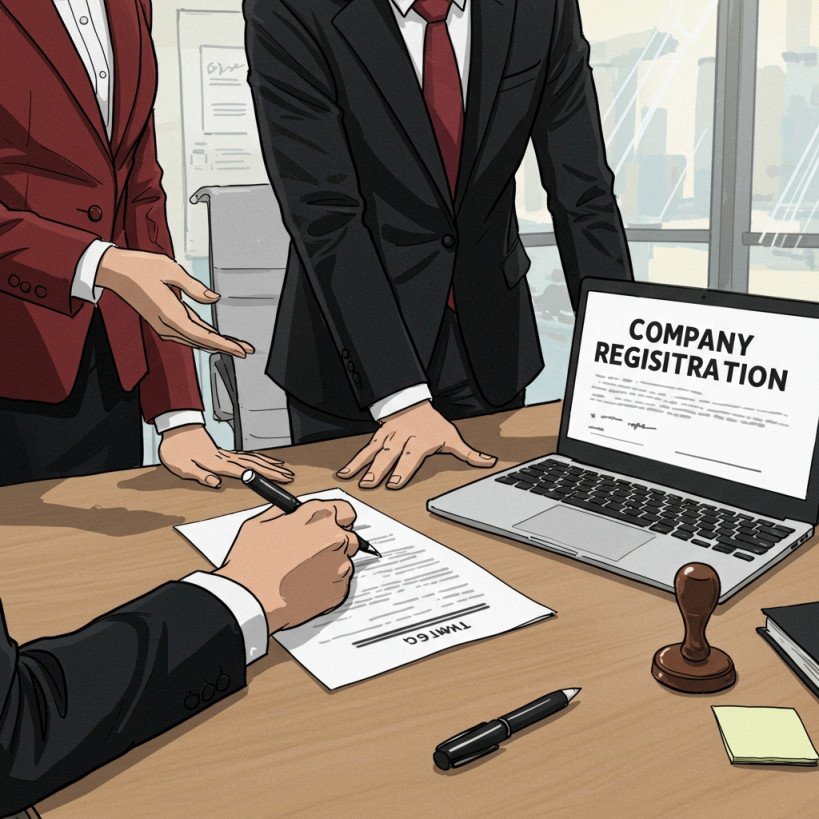


Private Company Registration Process: Step-by-Step Guide
Last Reviewed on: June 2026
Mastering the private company registration process in India requires precision. This guide delivers the tactical roadmap founders need to navigate the MCA portal, secure name approval, and launch officially.

Quick Answer: At a Glance
Searching for the immediate operational reality of the private company registration process? Here is the procedural overview every founder needs.
- Procedural Standard: Incorporation is managed entirely online via the SPICe+ web portal.
- Core Requirements: You need at least two directors, digital signatures (DSC), and a registered physical office address.
- Cost Range: Total setup costs typically range from ₹6,000 to ₹15,000 based on authorized share capital.
- Standard Timeline: The ROC typically processes flawless applications within 7 to 14 working days.
What is the Registration Process?
The private company registration process in India is the formal legal procedure of incorporating a business entity under the Companies Act. This regulatory framework creates a distinct, perpetual legal identity entirely separate from its shareholders. Successfully navigating this process is the mandatory first step for scaling any formal enterprise.
Why Proper Incorporation Matters
Understanding the registration process safeguards your personal financial assets and establishes necessary operational credibility. Formalizing your enterprise ensures you can operate legally and scale your ambitions safely. Exploring the BizSimpl homepage resources shows why serious founders prioritize this step.
- Limited Liability: Protects your personal assets from unexpected business debts or operational legal claims.
- Venture Funding: Institutional investors exclusively fund formal corporate entities, never informal partnerships.
- Corporate Banking: Registration is a mandatory prerequisite to secure a commercial current account.
- Brand Trust: A recognized corporate identity signals long-term stability to enterprise clients.
Compare: Private Limited vs LLP vs OPC
Choosing the correct framework is the initial phase of the registration process. The table below outlines the most common structures founders evaluate.
| Business Structure | Best Fit For | Key Benefit | Eligibility |
|---|---|---|---|
| Private Limited Company | Startups seeking scalable growth and venture capital. | Seamless equity distribution through ESOPs. | Minimum 2 directors and 2 shareholders. |
| LLP | Professional service firms not raising traditional equity. | Lower annual compliance requirements. | Minimum 2 designated partners. |
| One Person Company | Solo founders testing a self-funded idea. | Corporate liability with full founder control. | 1 sole director/shareholder. |
Critical Founder Decisions
Before executing the registration process, co-founders must achieve consensus on critical internal mechanics.
- Ownership Equity: Finalize the exact percentage split among founders to prevent future dilution disputes.
- Board Directors: Appoint individuals who hold executive compliance responsibility.
- Authorized Capital: Set the maximum share capital ceiling the company is legally allowed to distribute.
- Registered Address: Secure a permanent physical address for all official MCA communications.
The Registration Process
- Procure Digital Signature Certificates (DSC): The DSC mathematically authenticates all online MCA filings.
- Apply for Name Approval: Submit proposed brand names via the SPICe+ Part A portal.
- Draft Founding Documents: Prepare the Memorandum of Association (MoA) and Articles of Association (AoA).
- File SPICe+ Part B: This master form consolidates DIN allocation, PAN, and TAN applications. SPICe+ is filed through the MCA portal; the ROC reviews and approves it.
- Pay MCA Fees: Remit the required government fees digitally based on your authorized capital and state jurisdiction.
- ROC Approval: The Registrar of Companies verifies all forms and KYC. They issue the Certificate of Incorporation upon validation.
Most first-time founders underestimate how long DSC issuance takes. Start this step early before finalizing your registered commercial address.
Required Documents
- PAN Card: Mandatory identity proof for all directors.
- Aadhaar Card or Passport: Secondary identity and address verification.
- Recent Bank Statement: Must be under two months old.
- Passport-Sized Photographs: Digital copies for DSC and DIN.
- Utility Bill for Office: Electricity or water bill as address proof.
- NOC from Property Owner: Required if the office is rented.
Cost & Timeline
- Overall Costs: Professional and government fees typically range from ₹6,000 to ₹15,000.
- Standard Timeline: Processing spans 7 to 14 working days for flawless applications.
Common Mistakes & Rejections
- Trademark Conflicts: Applying for names already trademarked causes instant ROC rejection.
- Inconsistent KYC Data: Mismatched addresses on Aadhaar and bank statements trigger clarifications.
- Ignoring Post-Registration Duties: Failing to deposit initial capital within 180 days.
Frequently Asked Questions
Prioritize accuracy in your founder KYC documents to ensure your application passes ROC verification in the first attempt.
Launch Your Startup with Confidence
BizSimpl handles the entire regulatory workflow so you can focus on building your product.